


Ohio Vehicle Property Damage Guide for Crash Victims
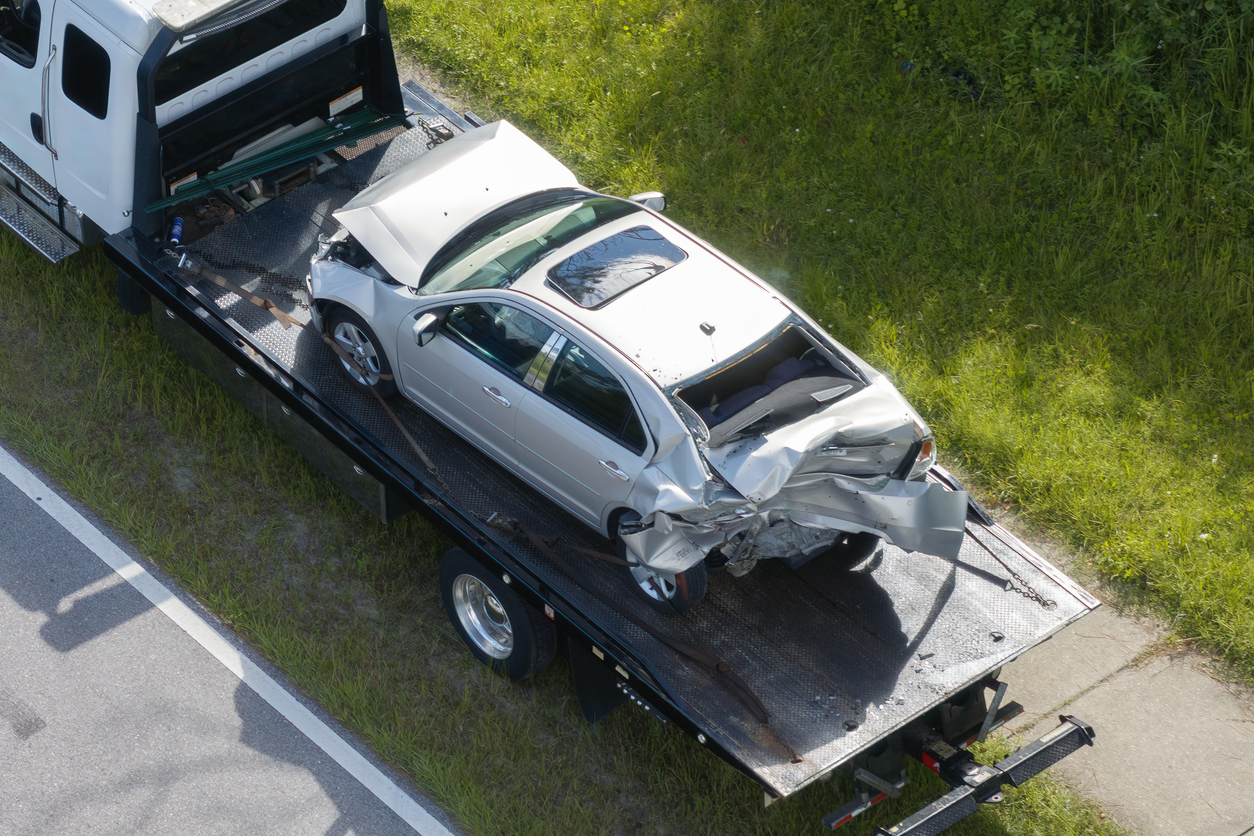
The experienced team at Charles E. Boyk Law Offices goes above and beyond to help our clients after devastating car accidents. We know how to navigate the confusing property damage claim process in Ohio, which involves critical deadlines, complex legal concepts, and logistical challenges.
This Ohio vehicle property damage guide for crash victims breaks down essential steps and key state laws you need to know, from securing a rental car and documenting damages to understanding “diminished value” and the fundamentals of negotiating a total-loss settlement. Whether you’re dealing with insurers or repair shops, being informed is your strongest asset for protecting your financial interests after a crash.
Immediate Steps at the Crash Scene and Key Ohio Laws
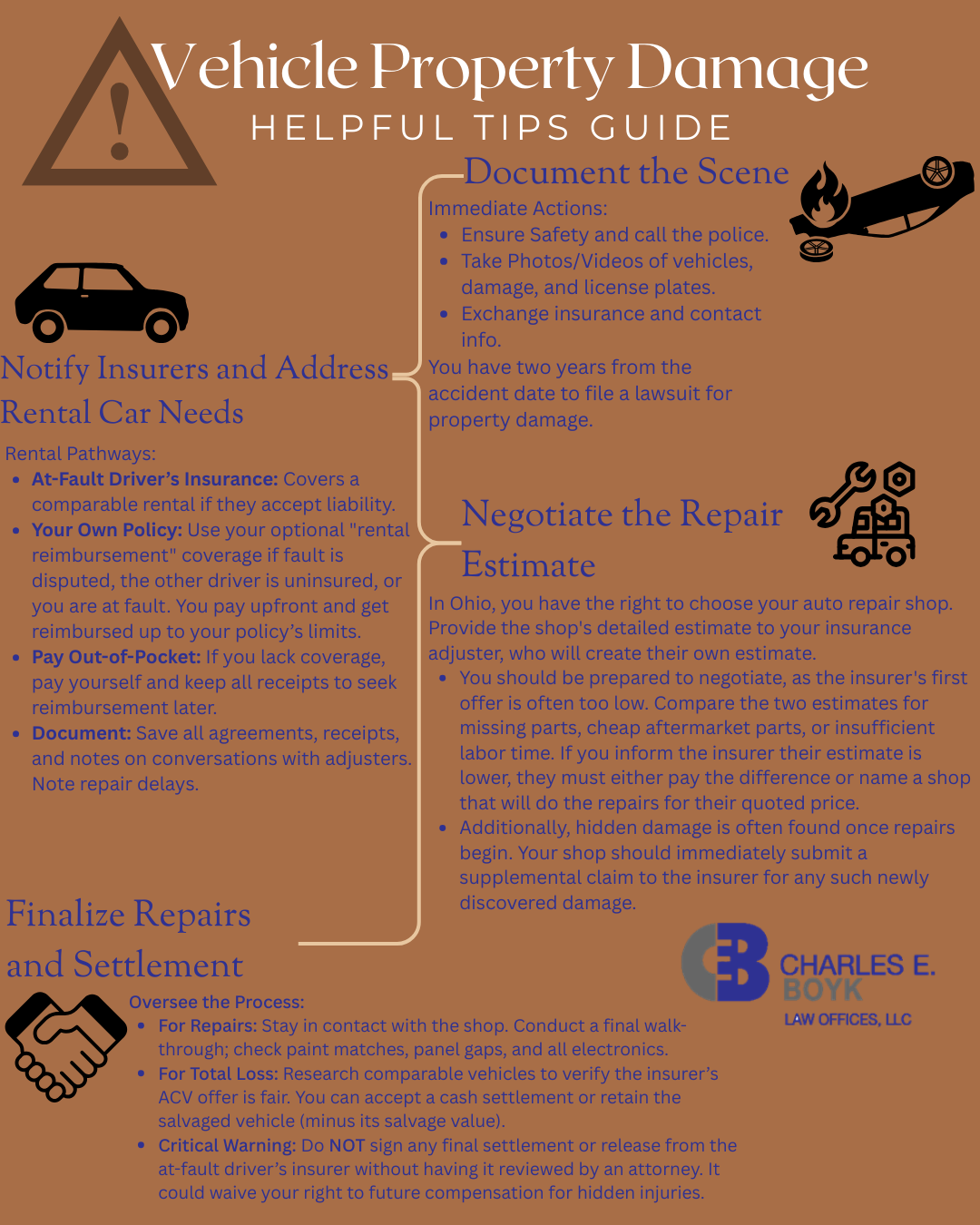
Your first actions after a car accident are critical. Before doing anything else, you should ensure everyone’s safety, call the police for an official report, get medical attention for any injuries, and document the scene thoroughly with photos and videos. Exchange insurance and contact information with the other driver.
From there, you can then focus on more practical matters, such as learning about Ohio property damage laws for crash victims.
Important Concepts to Understand
To fully exercise your rights in Ohio after a car crash and pursue an insurance claim or lawsuit for property damage, there are some key insurance-related terms you need to understand first.
Insurance Liability
Ohio is an “at-fault” state. The driver who caused the accident is responsible for your vehicle’s repair costs. Ohio law requires drivers to carry liability insurance, which MAY cover your rental expenses. If you were at fault or if the other driver lacks sufficient coverage, your own insurance policy may cover rental car benefits through rental reimbursement coverage—if you’ve opted for it.
It is important to save all rental agreements, receipts, and correspondence with insurance companies. If repairs on your car are delayed, note the reasons (e.g., parts backlog, repair complexity) to justify an extended rental period. Insurance policies have a maximum daily rate and total limit for rentals. Choose a vehicle within this budget to avoid out-of-pocket costs.
Statute of Limitations
You have two years from the accident date to file a lawsuit for property damage. Do not let negotiations cause you to miss this deadline.
Fair Market Value (FMV)
This is the price a willing buyer would pay a willing seller for your vehicle in its pre-accident condition (i.e., for vehicles that are not totaled) and is determined by comparing the value of other vehicles of the same year, make, and model in similar condition with similar mileage as yours that are within your area (often within a 20 mile radius of the address used in your insurance policy). FMV serves as a benchmark for settlements and is often used interchangeably with Actual Cash Value (ACV) in insurance contexts, though ACV specifically accounts for depreciation. In Ohio, if your vehicle is repairable, FMV helps calculate potential diminished value claims.
Gap insurance
When you buy a car, its value begins to depreciate rapidly. When your vehicle gets totaled after an accident, the actual cash value of the vehicle may be less than what you paid for the car. In this scenario, gap insurance can help you fill the gap between what you paid and what your car is worth. Without gap insurance, you may still owe money on your car if the actual cash value is less than what you paid.
Diminished Value
Even after repairs, your vehicle’s market value may decrease due to its accident history—a concept known as diminished value. This is the difference between the FMV before the accident and the FMV after repairs. In Ohio, you can claim diminished value from the at-fault driver’s insurance if you can prove the loss (e.g., via appraisals or market data). Claims must be filed within two years, and they’re more successful for newer or higher-value vehicles. If your car is repaired, consider getting an independent diminished value appraisal to strengthen your claim.
Totaled Fair Market Value (Total Loss Valuation)
If repair costs exceed the vehicle’s value (typically when repairs plus salvage value meet or exceed the ACV, with no fixed percentage threshold mandated by Ohio law—though insurers often use 75-80% as a guideline), the insurer declares it a “total loss.” In this case, you’ll receive the vehicle’s ACV (essentially its pre-accident FMV minus depreciation) minus any deductible. Research comparable sales in your area to verify the offer is fair, as insurers may undervalue based on their formulas. Ohio requires insurers to handle total loss claims promptly, generally within 21 days of receiving proof of loss, with possible extensions if notified.
UM/UIM Coverage
According to the Ohio Automobile Insurance Guide, approximately 15% of Ohio Drivers do not carry the insurance required by law. Many more drivers carry only the state minimum liability coverage (while this makes them “legal” these limits are often insufficient to cover the costs of a serious accident, leaving you vulnerable).
Insurers offer optional Uninsured (UM) and Underinsured Motorist (UIM). UM coverage acts as the at-fault driver’s missing liability insurance. It pays for injuries to you and your passengers if hit by a driver with no insurance.
UIM coverage takes over when the at-fault driver’s liability limits are too low to cover your medical expenses. It bridges the gap between their coverage and your actual costs.
How the Property Damage Claims Process Works
After a car accident in Ohio, securing transportation while your damaged vehicle is repaired is an important concern. This process of obtaining a rental car is determined by who is at fault and what insurance coverage applies. Disputes about fault and delayed claims are common. Here’s a guide to navigating the whole process.
Report the Accident to Both Insurance Companies
Report the accident to both your insurance company and the at-fault driver’s insurer immediately to start the claim process. A delay in reporting may hinder your ability to get a rental car covered.
There are three payment pathways, which include:
- Other Driver’s Insurance: If the other driver is at fault and their insurer accepts liability, they should arrange and pay for a comparable rental car directly
- Your Own Coverage: If fault is disputed, the other driver is uninsured, or you are at fault, you must rely on your own optional “rental reimbursement” coverage. You typically pay upfront and get reimbursed later, up to your policy’s daily and total limits
- Pay Out-of-Pocket for Reimbursement: If you lack rental coverage and the other insurer hasn’t accepted liability, you may need to pay for the rental yourself. Keep ALL receipts to seek reimbursement once the claim is settled
Contact the dedicated Toledo car crash attorneys at Charles E. Boyk Law Offices for help with the claims process.
Document Everything
From the moment you rent the car, keep a complete file including:
- The Signed Rental Agreement
- All Payment Receipts and Invoices
- Notes on conversations with adjusters, including names and dates
- Reasons for any repair delays (part backorders), as this may justify an extended rental period to the insurer
Our attorneys could assist you in ensuring you have all the proper documentation needed.
Limits and Reimbursements
Insurance policies have a MAXIMUM Daily Rate and a TOTAL CAP. You are responsible for ANY costs over these limits. Check your insurance policy for these limits.
IF you use your own coverage, your insurer may seek to recover the cost from the at-fault driver’s company later through a process called SUBROGATION.
Document Damage and Prepare for the Adjuster
Do not authorize repairs until the insurance adjuster inspects the vehicle. Provide them with your photos, videos, and any estimates you obtain from a repair shop of your choice. In Ohio, you have the right to choose your own shop.
Negotiate the Repair Estimate
The adjuster’s first offer is often a starting point and may be too low. Be prepared to negotiate:
Challenge the Details: Compare the adjuster’s line-item estimate with your shop’s quote. Look for omitted items, the use of cheap aftermarket parts, or insufficient labor time.
Submit Supplements: It is common for shops to find hidden damage (e.g., to the frame or sensors) during teardown. When this happens, the shop should immediately submit a supplemental claim with photos to the insurer for additional payment.
Finalize Repairs and Settlement
Your involvement doesn’t end when the car goes to the shop. Your involvement in the repair should include:
- Overseeing the Repair: Stay in contact with the shop. If the vehicle is declared a total loss, research your car’s market value to ensure the insurer’s “Actual Cash Value” offer is fair.
- Conducting a Final Walk-Through: Before taking final possession, inspect the repairs thoroughly. Check for paint matches, panel gaps, and that all electronics function.
- Reviewing the Release: Crucially, do not sign any final settlement or release from the at-fault driver’s insurance company without having it reviewed by an attorney.
An overbroad release could waive your right to claim compensation for hidden injuries that surface later.
Negotiate the Total Loss Settlement
If your vehicle is a total loss, you have two choices:
- Take the cash settlement for the ACV of your vehicle or
- You can “retain the salvage” and request the title and damaged vehicle be returned to you
Just know that many insurance companies will deduct the salvage value of the vehicle before selling it back to you. They also often report the damaged vehicle’s VIN number to a federal database so that any future buyers know it sustained major damage.
Most take the cash settlement, where the insurance company will pay out the vehicle’s pre-accident actual cash value. This is DIFFERENT FROM THE REPLACEMENT COST and factors in depreciation.
If you still owe money on a car loan, the insurance payout will first go toward paying off that debt (to your lienholder/bank/credit union). This may not cover the entire loan, meaning you’re responsible for the remainder. However, anything left over after paying the lienholder goes back to you. If you own your vehicle outright, the total loss payment goes to you.
How Our Firm Can Help With Ohio Vehicle Damage for Crash Victims
Dealing with adjusters, negotiating estimates, and understanding complex releases can be overwhelming while you focus on recovery. Our team is experienced in advocating for clients to ensure they receive a full and fair property damage settlement in Ohio after a car crash. Please contact us before you agree to any settlement in writing.
Commonly Asked Questions
Q: How soon after the accident can I get a rental car?
A: You can arrange one as soon as you open a claim with an insurance company. If you have rental reimbursement coverage on your own policy, you can use it immediately. If you’re relying on the at-fault driver’s insurance, you may need to wait for them to accept liability, which can sometimes cause delays.
Q: How long will the insurance pay for my rental?
A: Coverage typically lasts for the “reasonable repair time” of your vehicle or until it is declared a total loss. The rental period should align with the time the repair shop is actively working on your car. Keep in touch with your adjuster if repairs are delayed due to parts or other issues.

